
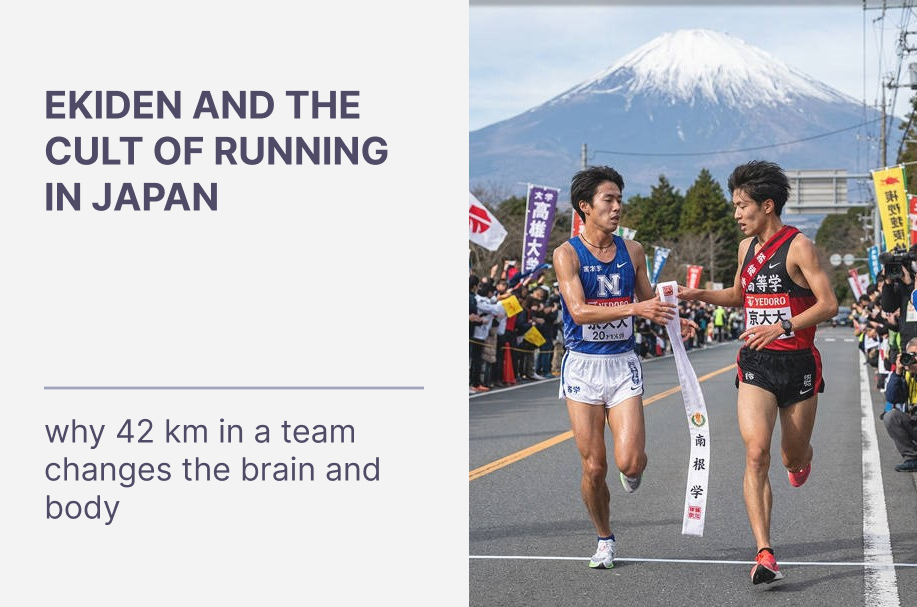
You have probably heard about the Japanese "obsession" with running. But there is something bigger than just marathons. In Japan, there is a cult of ekiden — a team relay race over a distance of 42.195 km, where each participant runs their stage, passing not a baton but a tasuki — a special sash worn over the shoulder.
The Hakone Ekiden (Tokyo-Hakone Round-Trip College Ekiden) draws more than 30% of the Japanese audience to theTV screens — a figure unmatched by almost any other sporting event in the world. But why?
💡 Because ekiden is not just running. It is a philosophy, a metaphor for life, and - as science suggests - a powerful training tool for the nervous system.
What Is Ekiden and Why Is It a Social Phenomenon

The first ekiden races appeared in Japan in 1917, and today it is a national sport. The concept: a team from a university or company completes a marathon-distance race in stages.
Researchers from Keio University describe it like this: "Ekiden is a team sport where individual ability matters, but teamwork is even more important."
📌 Unlike traditional running, where you are alone with the distance, here each participant does not run for themselves, but for the team. And this social context creates unique neurochemical changes.
How Running Rewires the Brain: The Science of the "Runner's High"
For a long time, it was believed that the euphoria after long-distance running is associated with endorphins. But recent research has busted this myth.
Key fact: Endorphins do not cross the blood-brain barrier, meaning they cannot directly affect the brain.
So what causes that feeling of lightness and calm after a good run?
Cannabinoids. Yes, your body produces its own cannabinoids — endocannabinoids (primarily anandamide). Unlike endorphins, they enter the brain, where they reduce anxiety, induce feelings of calm, and even mild euphoria.
📌 Moreover, a 2023 study in Frontiers in Psychology confirmed that it is precisely the increase in anandamide levels during aerobic exercise that is responsible for that very "runner's high".
Ekiden as an Anti-Stress Tool: Why Running Heals the Nervous System
Here is a paradox: running activates the "hypothalamic-pituitary-adrenal" axis — our central stress mechanism, leading to cortisol release. So why do runners feel calmer rather than more stressed?
Answer: the difference between "good" and "bad" stress.
Researchers distinguish between physical (good) and psychological (bad) stress:
- Bad stress (work, conflicts, anxiety) increases cortisol, but is not accompanied by an increase in growth hormone.
- Good stress (physical activity) increases cortisol and growth hormone, and also activates the endocannabinoid system.

Regular running also increases the density of cannabinoid receptors (CB1R) in the hippocampus — the brain region responsible for memory and emotions. Simply put: the brain becomes more responsive to its own calming signals.
Long-term effect: Studies on rats have shown that regular running training normalizes the autonomic regulation of heart rate, balancing the sympathetic and parasympathetic nervous systems.
Running and Neuroplasticity: The Birth of New Neurons
One of the most remarkable discoveries in recent years is that running can actually change the brain’s structure.
📌 Researchers from Johns Hopkins Medicine confirm that regular aerobic exercise stimulates neurogenesis — the birth of new neurons in the hippocampus. This region is essential for memory and learning.
How it works: running increases levels of BDNF (brain-derived neurotrophic factor) — a protein that works like "fertilizer for neurons." It promotes the growth of new neural connections and protects existing neurons from degeneration.
Important nuance: The effect depends on genetics, gender, and age. Studies show that in women and carriers of certain variants of the BDNF gene (Val66Met), the response may differ.
Ekiden and Cellular Rejuvenation: Running Against Aging
It sounds like science fiction, but runningcan slow biological aging.
A large NHANES study (4,458 American adults) showed that people who ran at least 75 minutes per week had significantly longer telomeres — the end sections of chromosomes that shorten with age. Long telomeres = a biologically younger organism.
Another study on ultramarathon runners (107 km) confirmed that those who have been engaged in endurance running for years have better preserved telomeres, especially in older age groups.
✔️ What this means: ekiden is not just a sport. It is an investment in longevity.
The Transcriptome of Running: How Exercise Switches Genes

The deepest understanding came from an unexpected source — research on... snails. Yes, scientists from the Institute for Biology of Development studied how physical activity changes gene expression in the nervous system.
Key discovery: physical activity and recovery activate different sets of genes. Exercise activates genes related to chromatin modification and the cell cycle. And recovery activates genes for neuronal development, synaptic function, and neuroplasticity.
💡 Conclusion: the combination of "exercise + proper recovery" is what maximizes the effect for the brain.
The Dark Side: How Not to Harm Yourself
Running is a powerful tool, but noе risk-free. A 1996 study on ekiden runners showed that intense summer training can cause a temporary decrease in immunity and a increase the risk of anemia.
📌 Scientists also found that even in elite runners, high loads can suppress the activity of neutrophils (immune system cells) if the body does not receive adequate support.
Nutritional Support for Runners: What the Body Needs
If you want to use running (or just an active lifestyle) to improve nervous system function, slow down aging, and combat stress, training alone is not enough - the body needs proper support.

✔️ Protecting cells from oxidative stress
Intense running increases the production of free radicals. A study on ultramarathoners showed that genetic variants associated with antioxidant protection (SOD2) influence how quickly telomeres shorten.
What to add: Antioxidant complexes, coenzyme Q10, astaxanthin, vitamins C and E
✔️ Supporting the nervous system and neurotransmitter production
Prolonged exercise can deplete dopamine and serotonin precursors. Recovery requires precursor amino acids: tyrosine (for dopamine) and tryptophan (for serotonin).
What to add: L-tyrosine, B vitamins (especially B6 and B12), magnesium. The Japanese version — fermented foods (miso, natto, tempeh), which improve the absorption of these nutrients.
✔️ For BDNF and neuroplasticity
BDNF depends on omega-3 fatty acids, especially DHA. Research shows that low omega-3 levels reduce the brain's ability for neurogenesis after physical activity.
What to add: Fish oil high in DHA, soy lecithin (source of phosphatidylcholine for myelin sheaths), collagen with ceramides (support for connective tissue of joints and ligaments).
✔️ For recovery after exercise

Adaptation of the nervous system happens precisely during the rest phase. Without quality recovery, running becomes a destructive rather than a strengthening factor.
What to add: Adaptogens (ginseng, rhodiola, ashwagandha), BCAA amino acids (prevent catabolism), collagen (for tendons — a risk zone for runners).
Instead of a Conclusion: Running as a Lifestyle
Ekiden is not about medals. It is about teamwork, perseverance, and the quiet realization that you are capable of more than you thought. And now we have scientific proof: it is also about a healthier brain, a more resilient nervous system, and a longer biological lifespan.
📌 Running is the best thing an ordinary person can do for their brain. But only if you give your body what it needs to recover.