
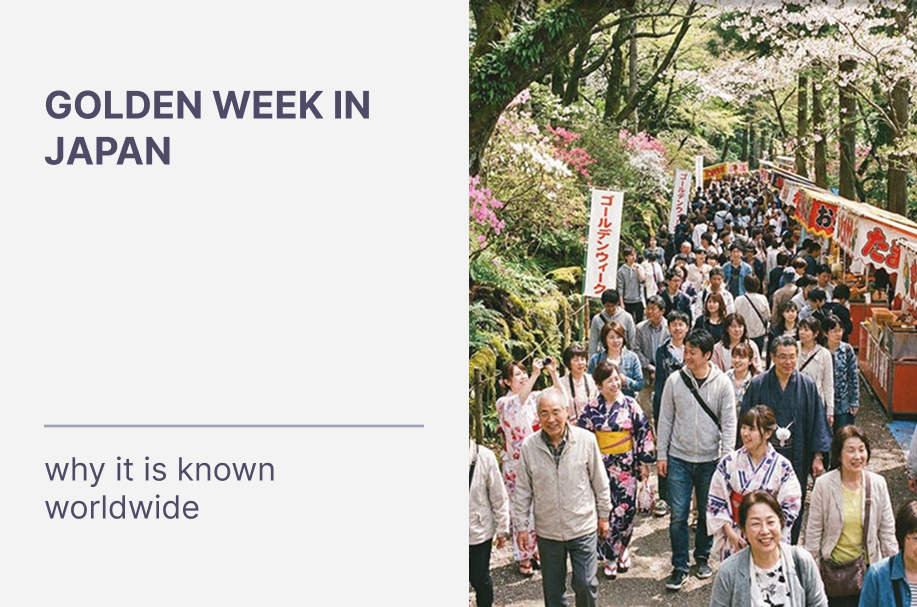
Every year in late April to early May, something amazing happens in Japan. A country known for its diligence and discipline suddenly slows down. Millions of Japanese people pack their bags, train stations become crowded, and hotels are booked months in advance. This is not a natural disaster, but a long-awaited and beloved phenomenon — "Golden Week". In this article, we will explain what this period is, how and when it appeared, and why, for tourists, it can be can be both the best and the most challenging time of the year.
Historical Background: Why is the Week "Golden"?
Golden Week is a period when several national holidays follow each other in Japan. Some simply call them "a long May holiday," but behind this lies a whole story.
The name actually comes from... the film industry. In 1951, the management of the major film studio Daiei Film Co., Ltd. noticed that when several days off fell within a single week, people flocked to movie theaters. The box office revenues were so high that it reminded the studio director of the radio term "Golden Time" (prime time, the best time for broadcasting). Thus, the term "Golden Week" (黄金週間, Ogon Shukan) was born.
💡 Interestingly, while the Japanese translation exists, the English phrase Golden Week became so widely used that it remains the standard term today.
The Philosophy of Self-Care: Why Golden Week is More Than Just Days Off
To outsiders, it might seem unusual that an entire country eagerly prepares for a week-long break. In Japan, where the culture of hard work and overtime (karoshi) sometimes escalates to the extreme, Golden Week serves not just as a holiday but as a sacred pause.
In traditional Japanese culture, the concept of "ikigai" (生き甲斐) — the "reason for being" — is what a person gets up for in the morning. For a long time, it was believed that ikigai lies in work and service to society. Today, however, many people are rethinking that balance, placing greater importance on rest and personal well-being.
Golden Week becomes an ideal moment for practicing "shinrin-yoku" (森林浴) — "forest bathing" — walks in nature to relieve stress, for family gatherings, and for resetting.
Another concept of "mottainai" (もったいない) — the regret of wasting something valuable — becomes especially evident. A Japanese person who does not take a vacation and stays alone in an empty metropolis risks being seen as someone who respects neither their life nor their work.
✔️ Thus, for a Japanese person, Golden Week is not just five days off on the calendar. It is part of the cultural code: kyōtsu no jikan (time together).
2026 Holiday Calendar: What Does Golden Week Consist Of?
Golden Week is not a single holiday, but a cluster of four (and sometimes five) national holidays.
In 2026, it falls between April 29 and May 6.
Here are the holidays included in this period:
- Shōwa Day (April 29)
The first day of the holidays. It is named after Emperor Hirohito, who reigned during the Shōwa period. Originally this day was his birthday, and after his death, it became a day of remembrance for a difficult time for the country. On this day, people reflect on history. - Constitution Memorial Day (May 3)
A holiday dedicated to the enactment of Japan's new constitution in 1947. It is a symbol of democracy and peace. - Greenery Day (May 4)
A day dedicated to nature. Japanese people are known for their love of plants, and this holiday encourages people to cherish and protect the environment. Many national parks are free to enter on this day. - Children's Day (May 5)
The culmination of the Golden Week. This is a festival for boys (there is a separate one for girls — Hinamatsuri). On this day, bright carp-shaped flags — "Koinobori" — soar over houses and in parks. The carp symbolizes strength, courage, and the ability to swim against the current, which parents wish for their sons.
📌 Important nuance: Not all days between these holidays are official days off. However, many companies close for the entire period, or employees take paid leave, effectively extending the break.
What Happens in Japan During Golden Week?
Golden Week is the peak of domestic tourism in Japan.
- Mass travel: According to statistics, millions of people travel during these few days (figures can reach tens of millions of trips). Statistics show that the number of travelers during this period can exceed 27 million people.
- Crowds everywhere: Shinkansen (bullet trains) are packed to capacity, and hotel rooms need to be booked six months in advance.
- Higher prices: Accommodation costs can increase several times compared to regular days.
Is It Worth Visiting Japan as a Tourist at This Time?
✔️ Pros:
This is a time of spectacular festivals. During Golden Week, celebrations are held everywhere: you can see the launch of real giant kites, craft fairs, and parades. The weather in late April – early May is ideal for walking: it's warm, cherry blossoms are blooming (but not in Tokyo, rather in the north like Hokkaido or in the mountains), and the exhausting summer heat has not yet arrived.
✔️ Cons:
If you are counting on a budget trip, Golden Week is the most expensive time of the year. If you don't like crowds, this time is best spent away from major tourist centers like Tokyo, Osaka, and Kyoto.
📌 Tip: if after reading this you've already started mentally packing your suitcase, but don't know which Japanese skincare and energy products to take on the road to cope with the flight and climate change, we have a ready guide. "What to Take on a Trip to Japan: A Checklist from OkinoJapan" — a selection that will make your trip not only bright but also comfortable for your health.
For Japanese people, Golden Week is a light at the end of the tunnel after long months of work — a chance to reconnect, recharge, and travel. For visitors, it offers a unique opportunity to see Japan in a different light: lively, festive, and full of movement.
And although in 2026 we may not be able to personally walk the streets of Tokyo in the midst of the carnival, knowing these traditions brings us closer to the culture of the Land of the Rising Sun.